Born in the National Park: A Cormorant’s Journey to Portugal
Cormorants are highly flexible migratory birds that often travel over short distances. However, depending on temperature and weather conditions, they also fly longer routes. This was the case for a specimen born 16 years ago in the Lower Oder Valley National Park. It has now been found in Portugal, providing exciting insights into its migratory behavior.
As reported by the Hiddensee Bird Ringing Centre, a cormorant (Phalacrocorax carbo) ringed in the Lower Oder Valley National Park was recently rediscovered in Portugal. The bird, which perished there last winter, was found near the Ceira River in the central part of the country. Its origin was determined via a leg ring with the identification DEH UA 76.
Born and Ringed in the National Park
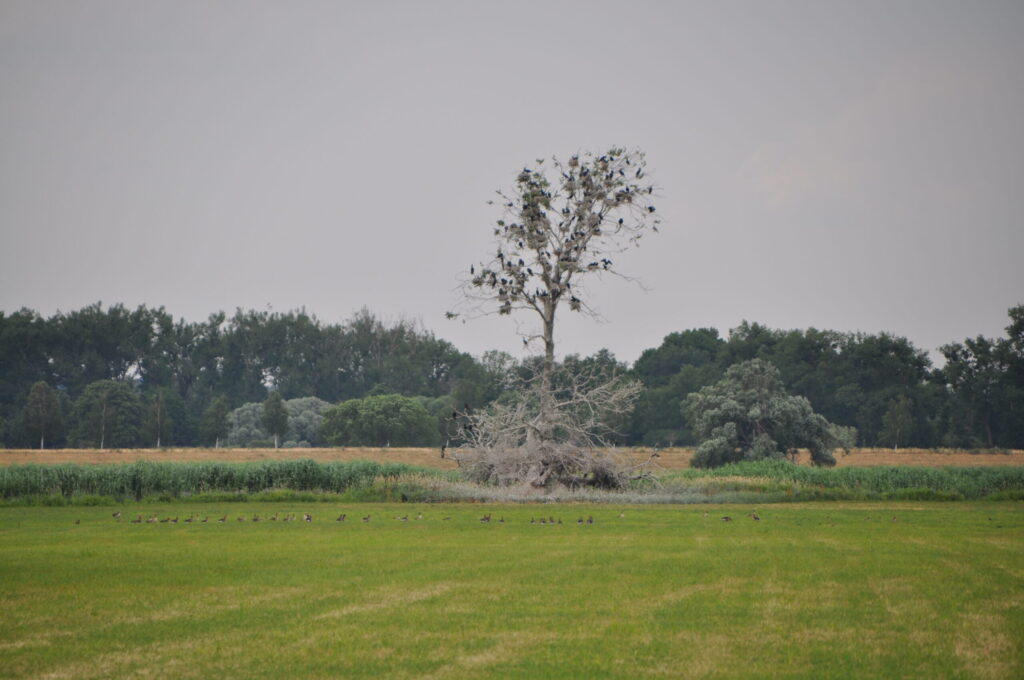
In 2010, it was ringed as one of four nestlings in a breeding colony within the National Park by staff from the Brandenburg State Bird Conservation Centre. The bird thus reached an age of almost 16 years in the wild. Although this find represents the oldest ringed cormorant from the Lower Oder Valley to date, cormorants can live to be over 20 years old. Three sightings of an additional colored identification ring provide information regarding this cormorant’s previous whereabouts.
From the Lower Oder Valley to Portugal
According to the records, it stayed in Schleswig-Holstein at the end of September 2012, but did not winter on the North or Baltic Sea coasts; instead, it surprisingly moved further to Portugal, where it was sighted at the end of November, just 22 km from its final recovery site. In February 2015, its color ring was sighted again—only 5 km from the previous observation site. Now, 11 years later, its final record was made in the same region. These three records characterize the observation area as the bird’s wintering ground. Unfortunately, no records were obtained from the bird’s breeding ground, which is likely located in Germany or Western Poland.
The Development of the Cormorant in the Lower Oder Valley
Between 2001 and 2018, 1,319 cormorants were ringed in the National Park as part of a ringing program by the Hiddensee Bird Ringing Centre. Since then, there have been 547 ring sightings of 147 living birds, as well as 76 recoveries of dead birds. Pronounced site fidelity for wintering grounds has been proven multiple times, both for migratory birds and for those wintering in their birth region. Siblings, for example, left the home colony separately, as they were never observed at the same time and only exceptionally in the same stopover areas. Consequently, wintering grounds were also often located far apart.
The wide dispersal of the birds is likely part of the species’ survival strategy; it distributes and thereby minimizes the risks of death due to harsh winters or deterrent culling. Some birds were later sighted as breeding birds in their birth colony, while others were found in colonies in Mecklenburg-Western Pomerania and Western Poland. Scientific bird ringing programs therefore consistently provide exciting data on the biology and ecology of native birdlife.
The fish hunter is a typical bird of large to medium-sized rivers and floodplain landscapes, such as those found in the Lower Oder Valley. In the National Park, following settlement attempts in 1979 and from 1986 to 1988, breeding colonies were established from 1992 onwards, sometimes with over 1,000 breeding pairs. After raccoons first contributed to significant breeding losses in 2011, the breeding population fell despite increasing relocations due to declining breeding success and a reduced reproduction rate. The last successful brood was recorded in 2024. The cormorant population in Brandenburg reached its peak in the early 2000s with approximately 2,800 breeding pairs. From 2011, it declined significantly nationwide, but has remained stable since 2018 at between approximately 850 and 1,200 breeding pairs.